Top Tips for Choosing the Right Tig Machine for Your Needs?
Choosing the right Tig machine can be a daunting task. With so many options available, it’s essential to understand your specific needs. Industry expert John Smith, a respected welder and equipment consultant, emphasizes, “The right Tig machine can make or break your project efficiency.” His experience highlights the significance of selecting an appropriate machine for optimal results.
When considering a Tig machine, think about your welding projects and materials. For instance, aluminum and stainless steel require different machines. Compact models are ideal for small workshops but may lack power. Heavier machines might offer more functionality, yet they can be cumbersome.
While it’s tempting to focus solely on price, consider durability and brand reputation. Not all inexpensive machines perform well. Some brands may appear reliable but could lead to frequent repairs. Finding a balance is crucial. Ensure the machine's features align with your welding style and environment. Taking the time to research and reflect on your unique requirements will pay off in the long run.
Understanding the Basics of TIG Welding Machines
When selecting a TIG welding machine, understanding the basics is crucial.
TIG, or Tungsten Inert Gas welding, is known for its precision.
It uses a non-consumable tungsten electrode to produce the weld. This method is ideal for thin materials and
stainless steel. A good machine will have a balance of power and control. Look for features like
high-frequency start and adjustable settings.
Welding with TIG requires practice. Many beginners find it challenging due to the need for steady hands and patience.
The welder must control the heat input carefully to avoid warping. A foot pedal can help in managing the current flow.
This allows the welder to adjust on the fly. However, not every machine needs a foot pedal. Some may prefer a different setup,
which requires careful consideration.
Choosing a TIG welder can be daunting. Many factors come into play—thickness of materials, type of metal,
and desired results. Understanding these elements helps narrow down choices. It's easy to feel overwhelmed,
but learning through experience can guide you. Reflecting on past choices
and mistakes can lead to better decisions.
Key Features to Consider in a TIG Machine
When choosing the right TIG machine, consider key features that suit your needs.
Power source type is crucial. Look for machines that provide both
DC and AC capabilities.
DC is ideal for steel, while AC works well for aluminum.
Understanding this distinction can save time and material.
Another important feature is the duty cycle. A higher duty cycle means
the machine can operate longer without overheating. If you plan to work on larger projects, this aspect becomes vital.
It’s frustrating to wait for the machine to cool down when you’re in the middle of a job.
Don’t overlook portability. If you need to move your machine, weight and design matter.
Many compact models offer substantial power while being easy to transport. Balance is key.
Test before you buy. Understand the usability of controls and settings. Tweaking parameters can significantly impact weld quality.
As you consider these features, think about your own experience and comfort.
Everyone learns at their own pace. What works for you may not work for others.
Reflection is essential. Assess your past projects to determine which features were beneficial.
Learn from each action, and choose wisely.
Assessing Your Welding Needs and Applications
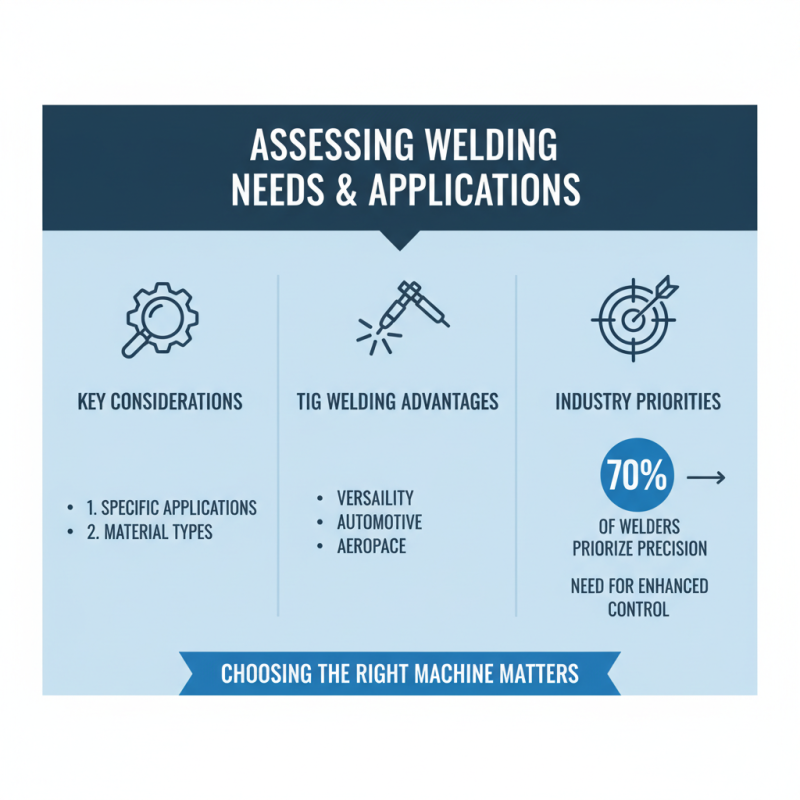
When assessing your welding needs, understanding the specific applications is crucial. The versatility of TIG welding makes it favored in various industries, including automotive and aerospace. According to industry reports, 70% of welders prioritize precision, highlighting the need for a machine that enhances control.
Identifying the materials you will work with can guide your choice. For example, aluminum and stainless steel require different settings and capabilities. Assessing metal thickness is also important. Machines designed for thicker materials may not perform well on thin sheets. Research indicates that 55% of new welders struggle with material compatibility, which can lead to wasted resources.
Additionally, consider the machine's power requirements. A reliable power source ensures consistent operation. Many professionals recommend machines with adjustable amperage for better adaptability. Experts emphasize that the balance between features and simplicity is key. A machine with too many settings can overwhelm beginners. Aim for a model that offers essential functionalities without unnecessary complexity.
Comparing Different Brands and Models
When selecting a TIG machine, it's crucial to compare different brands and models. Each brand comes with unique features tailored for specific tasks. Some machines offer advanced controls for precise welding, while others focus on portability. Your choice will depend on the types of projects you undertake. Identifying whether your work requires high versatility or simplicity can guide your decision.
Quality varies significantly among brands. Research user reviews to gauge performance. One brand may excel in lightweight designs but fall short in durability. Another might be robust yet cumbersome. Evaluate how often you will move the machine. Weight and size play a critical role in usability. Trying out demo models can also reveal how comfortable and intuitive the controls are.
Don't overlook after-sales support and warranty terms. Some brands offer extensive customer service, while others may leave you frustrated. It's also worth checking for parts availability. You don’t want to struggle with a machine due to hard-to-find replacement components. An informed choice will enhance your welding experience and satisfy your project needs.
Budget Considerations for Purchasing a TIG Machine
When considering the purchase of a TIG machine, budget plays a critical role. Recent industry reports indicate that a significant portion of buyers, about 45%, consider the price as their primary factor. This reflects a growing need among users to balance cost with functionality. A basic TIG machine can start as low as $400, but skilled welders often seek models in the $1,500 to $3,000 range for better reliability.
Investing in a higher-end machine may enhance your projects. These models usually offer advanced features like better arc stability and adjustable pulse settings. However, financial constraints can lead to compromises. Nearly 30% of buyers reported regretting their choice due to limited features. It's important to evaluate your welding needs carefully. Consider whether you'll tackle professional projects or hobby-level tasks. This assessment can help align your budget with the appropriate machine type.
Many buyers also overlook additional costs such as consumables and maintenance. These ongoing expenses can add up. For instance, replacement tungsten electrodes and filler materials may cost more than expected. A thorough budget should account for these factors to avoid future financial strain. Engaging with industry forums or consulting experienced welders can inform better decision-making. Balancing upfront costs with long-term value is vital for an effective purchase.

 WeChat Online Service