Top 10 Electric Welding Machines in China for Global Buyers?
In the evolving landscape of industry, the demand for Electric Welding Machines continues to rise. As global buyers seek reliable and efficient equipment, the choices can be overwhelming. Industry expert Dr. Wang Jun asserts, “Quality in welding machines is non-negotiable for achieving precision and safety.” His insight highlights the importance of selecting the right machine.
China's market is flooded with options that cater to various needs. However, not every Electric Welding Machine meets the standards of reliability and performance. This raises questions about the criteria that define a top-tier machine. Buyers may grapple with understanding specifications and assessing quality.
Amidst this complexity, informed decisions are crucial. Selecting a machine without proper research can lead to regrets. In that sense, exploring the best options is more than just a list; it requires critical evaluation. As we delve into the top choices available, it's essential to reflect on what truly matters in a welding machine—durability, efficiency, and support.
Overview of Electric Welding Machines Market in China
The electric welding machines market in China has experienced significant growth in recent years. This surge is driven by industrial expansion and rising demand in construction and manufacturing sectors. Chinese manufacturers have adopted advanced technologies to produce high-quality welding machines. These machines cater to various applications, from light repairs to heavy-duty welding tasks.
However, the market is also facing challenges. Many manufacturers struggle with quality control and maintaining consistent standards. Some electric welding machines may not meet international safety regulations. Buyers need to be cautious and conduct thorough research before making a purchase. Reliability and performance can vary widely among different products.
Moreover, exporting electric welding machines comes with its own set of hurdles. Understanding local regulations in target markets is essential. Compliance ensures smooth entry and acceptance. Continuous innovation will be crucial for manufacturers to stay competitive. The goal is to balance performance and affordability while meeting the evolving needs of global buyers.
Key Features to Consider When Choosing Welding Machines
When selecting a welding machine, important features require attention. Consider the type of welding: MIG, TIG, or Stick. Each has distinct applications. For instance, MIG welding excels in speed and ease, ideal for beginners. TIG offers precision but demands more skill. Data indicates that MIG is the most popular choice, capturing about 60% of the market share.
Power rating is crucial, typically measured in amperes. Machines with higher amperage can weld thicker materials, suitable for industrial projects. A report by the Welding Equipment Manufacturers suggested that machines rated above 200 amps account for 30% of global sales, particularly in construction and manufacturing industries.
Portability often matters for job sites. Some machines are lightweight, enhancing mobility. Yet, lightweight models may lack robustness. Durability can be an issue in varying environments. Therefore, choosing a well-balanced machine that offers both portability and durability is essential. Always assess warranty and customer support as reliable service can make a difference in long-term use.
Top 10 Electric Welding Machines in China
Top 10 Electric Welding Machines: Criteria for Selection
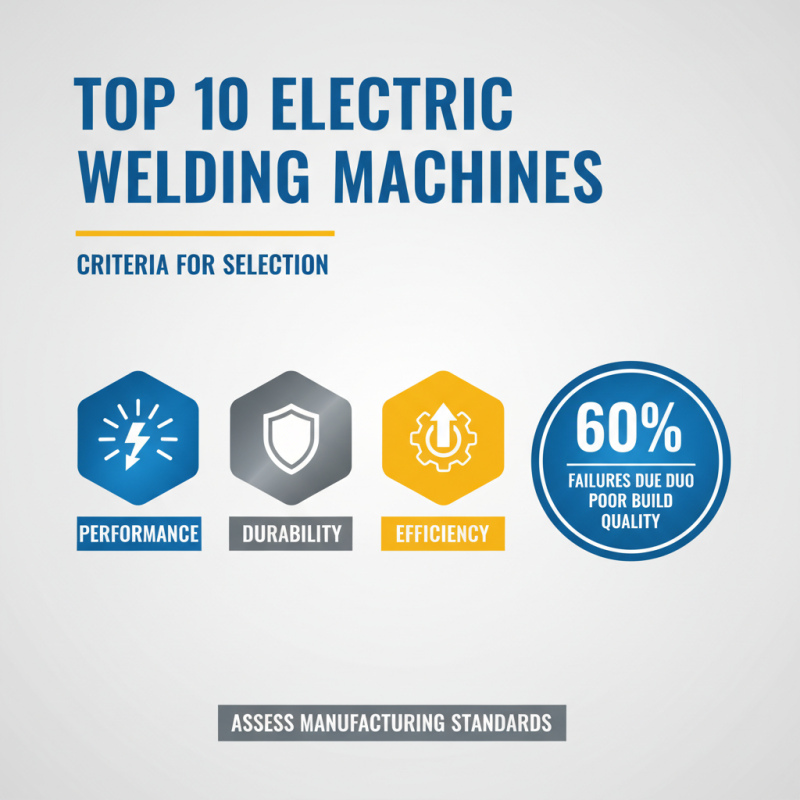
When selecting electric welding machines, buyers should focus on key criteria. Performance, durability, and efficiency are crucial. According to recent industry reports, 60% of welding machine failures relate to poor build quality, emphasizing the need to assess manufacturing standards.
Another important factor is versatility. A machine that can handle various welding techniques offers greater value. Data suggests that multi-process machines can increase productivity by up to 25%. This adaptability allows users to tackle a wider range of projects effectively.
Tips for selection: Always check for certifications and user reviews. These are indicators of reliability. Also, consider the machine's power output. Machines with higher duty cycles can operate longer without overheating. Remember, investing in a quality machine can lead to significant long-term savings. Quality often trumps cost. Reflect on your specific needs; don’t rush the decision.
Detailed Review of the Leading Electric Welding Machines in China
Electric welding machines are integral in modern manufacturing. In China, these machines are known for their efficiency and cost-effectiveness. According to recent industry reports,
China's electric welding equipment market reached approximately $10 billion in 2022, showcasing significant growth potential.
Most machines use various technologies such as MIG, TIG, and stick welding. MIG welders, for instance,
are favored for their ease of use and versatility. They account for nearly 40% of the market share. However, buyers often struggle to find the right balance between price and quality.
An overwhelming number of options can lead to poor purchasing decisions.
While many machines boast high performance, not all meet safety and durability standards. A report published by an industry authority highlighted that around
15% of cheaper models failed quality checks. Buyers need to conduct thorough research and rely on detailed reviews. Usage considerations, maintenance factors, and warranty terms should not be overlooked.
High-quality machines might have a higher upfront cost but prove to be more reliable in the long run.
Buying Tips for Global Customers: Navigating the Chinese Market
When navigating the Chinese electric welding machine market, global buyers should be well-informed. China dominates the global welding machine production, accounting for over 40% of the world's output. This statistic highlights the importance of understanding local suppliers. High-quality machines often come with superior technology and innovation, but this varies significantly between manufacturers.
A common challenge buyers face is assessing the reliability of Chinese brands. Many companies may lack transparency. It's crucial to look for certifications, such as ISO and CE, indicating compliance with international standards. Industry reports suggest that machines with these certifications exhibit lower failure rates, contributing to better performance.
Another point for reflection is the need for after-sales service. A strong support network can make a difference in operational continuity. Buyers should research warranty policies and service availability. Establishing a local contact can ease communication and troubleshooting. Investing time in due diligence ultimately leads to smarter purchasing decisions.
Top 10 Electric Welding Machines in China for Global Buyers
| Model |
Voltage (V) |
Welding Current (A) |
Weight (kg) |
Features |
Price Range (USD) |
| Model A |
220 |
150 |
20 |
Inverter Technology, Auto Voltage Sensing |
400 - 600 |
| Model B |
380 |
200 |
25 |
MIG/TIG Capable, Digital Display |
500 - 800 |
| Model C |
220 |
250 |
30 |
Portable, High Duty Cycle |
600 - 900 |
| Model D |
380 |
300 |
35 |
Multi-Process, Efficient Cooling |
800 - 1200 |
| Model E |
220 |
180 |
15 |
User-friendly Interface, Lightweight |
300 - 500 |
| Model F |
380 |
400 |
50 |
Heavy Duty, Enhanced Safety Features |
900 - 1300 |
| Model G |
220 |
230 |
22 |
Compact Size, Good for Home Use |
350 - 550 |
| Model H |
380 |
350 |
45 |
High Performance, Long Lasting |
1000 - 1500 |
| Model I |
220 |
160 |
18 |
Easy to Operate, Great for Beginners |
250 - 400 |
| Model J |
380 |
350 |
40 |
Advanced Technology, Low Noise |
1100 - 1550 |

 WeChat Online Service